
How to Search Criminal Dockets
The Putnam County docket index lists date-specific Circuit Criminal and General Sessions Criminal PDFs. It works best when the hearing date is known. Putnam TnCIS Web Inquiry searches Circuit Court or General Sessions information by party name or case number. Its full dynamic field list was not exposed in the reviewed source, so rely on the court, case-type, name, number, and document choices shown by the live system.
Identify the court before searching a Putnam County criminal docket. Keep the full number and year if possible. Municipal matters may remain with Algood, Baxter, Cookeville, or Monterey City Court. Tennessee appeals use Public Case History, while federal criminal cases use PACER. Those records do not merge into the county docket index.
- Open the docket index for a known date, or Putnam TnCIS for a name or number search.
- Select Circuit Court or General Sessions and the criminal case type shown.
- Match the full number, year, court prefix, and party before opening a result.
- Read each count, statute, setting, status, bond field, and continuation note separately.
- Ask the Circuit Court Clerk for current status or a filed order when needed.
Putnam Criminal Docket Numbers
Putnam County criminal docket numbers identify both court and case type. Circuit samples use 71CC1-YYYY-CR-NNN. General Sessions samples use 71GS1-YYYY-CR-NNN. The `CC1` and `GS1` segments point to different courts, while `CR` marks an observed criminal record. A `TR` suffix belongs to the General Sessions traffic docket instead.
This distinction prevents a common error. A matter that moves from General Sessions to Circuit may have related events at both levels. Search the number exactly, but check the other court when the docket reflects a boundover or appeal. Several count lines can belong to one Putnam County criminal docket number.
- 71CC1
- Observed Putnam Circuit Court identifier.
- 71GS1
- Observed Putnam General Sessions identifier.
- CR
- Criminal case-type segment.
- Count
- One charge line within a case.
What a Criminal Docket Shows
A Putnam County criminal docket PDF is a calendar snapshot with structured fields. Circuit rows may show the State caption, defendant role, attorney or Public Defender, filing date, separate counts, T.C.A. citations, offense classification, bond, hearing type, notes, status, and continuation. General Sessions rows may add a violation date and citation. The docket does not automatically display each charging paper, plea, judgment, sentence, or filed order.
| Case Number | Court, year, type, and sequence, such as 71CC1-2026-CR-NNN. |
|---|---|
| Count and Statute | Each alleged offense and its T.C.A. citation. A charge is not a finding of guilt. |
| Bond | Observed fields include bond type, amount, and surety. |
| Hearing | Arraignment, bound-over status, grand-jury return, negotiation deadline, or another event. |
| Status | Procedural notation, including continuation text. The filed order controls the outcome. |
Read the PDF header as well. It identifies the court, selected time and date, and judge. The clerk says most dockets are posted one day before court, so a missing future PDF may simply not be online yet.
Putnam Criminal Setting Terms
Local labels describe steps, not final results. “Arraignment” appears in General Sessions material. “Bound-Over Status,” “Grand Jury Return,” and “Hearing Negotiation Deadline Date” appear in the Circuit sample. A continuation means the matter was reset or carried forward; it does not mean the charge was dismissed.
The Putnam County criminal docket places the T.C.A. statute and count beside the offense text. Read them as separate fields. Check classification letters against the cited statute because the research does not establish a full code key for every letter.
- Arraignment
- A charge and plea-stage hearing, not a disposition.
- Bound-over status
- A Circuit setting tied to the General Sessions path.
- Grand Jury Return
- A procedural Circuit event.
- Case Continued
- A reset that requires checking the new date.
Stages on a Criminal Docket
A Putnam County criminal docket may begin in General Sessions with a filing, arraignment, bond information, and later setting. A bound-over matter can proceed to Circuit Court, where the calendar may show a grand-jury return, negotiation deadline, plea setting, trial, disposition, or sentencing. Not every case follows every step, and one PDF may capture only the event set that day.
Docket flow: Filing › Arraignment › Pretrial › Plea or Trial › Disposition › Sentencing
Charging papers, bond documents, orders, plea materials, judgments, sentencing papers, and appeal filings may be separate. TnCIS may offer documents where the court permits access. Otherwise, request the named public document from the clerk.
Putnam Criminal Counts in Context
The Tennessee Administrative Office of the Courts reported 1,648 criminal offense filings and 1,712 dispositions for Putnam's District 13 in fiscal year 2024. These are offense and administrative counts, not counts of unique people. Filings included 572 drug counts, 328 probation-violation counts, and 187 burglary or theft counts.
“Nolle prosequi” means the prosecution did not proceed on that charge at that point. The report also lists pleas, trials, diversions, transfers, and other outcomes. Aggregate figures do not prove the history or result of a specific Putnam County criminal docket.
Which Court Holds Criminal Dockets
The Circuit Court Clerk keeps and publishes Putnam County Circuit and General Sessions criminal docket material. The office also handles appeals and boundovers and prepares or maintains warrants, capias, mittimus, orders, and courtroom notes within its duties. General Sessions criminal dockets are commonly set Monday, Wednesday, and Friday, but the dated PDF and clerk confirmation control.
Juvenile access can be limited. Municipal matters stay with city clerks. State appeals use Tennessee Public Case History. Federal criminal records for the Middle District of Tennessee use PACER. The county clerk cannot certify a federal docket.
For Circuit and General Sessions questions, call 931-528-1508 or visit 421 East Spring Street, Room 1C, Suite 49A, Cookeville, during posted weekday hours from 8:00 a.m. to 4:00 p.m.
Putnam Recovery Court References
Official county records identify the 13th Judicial District Drug Court, begun in 2011, and Veterans Treatment Court, begun in 2015. A recovery-court setting or order may appear inside an underlying Putnam County criminal docket. That does not make participant lists, treatment notes, counseling details, or service records part of the public daily calendar.
Search the public criminal case through the Circuit Clerk or TnCIS, then ask for a specific public order or setting. No separate current Putnam recovery-court docket portal was located. The official program source gives history, not a live participant calendar.
Putnam Criminal Record Requests
When a document is absent from the daily Putnam County criminal docket, email recordsclerk@putnamcountytn.gov with the party name, full case number, and year. State whether inspection or a copy is needed and identify the order, judgment, bond paper, or other item. Requests can also go to the counter, by phone, by mail, or by fax at 931-526-2004. Ask whether a public terminal is available because the official sources did not confirm one.
The official Circuit Court Clerk contact page shows the access point for criminal record follow-up.
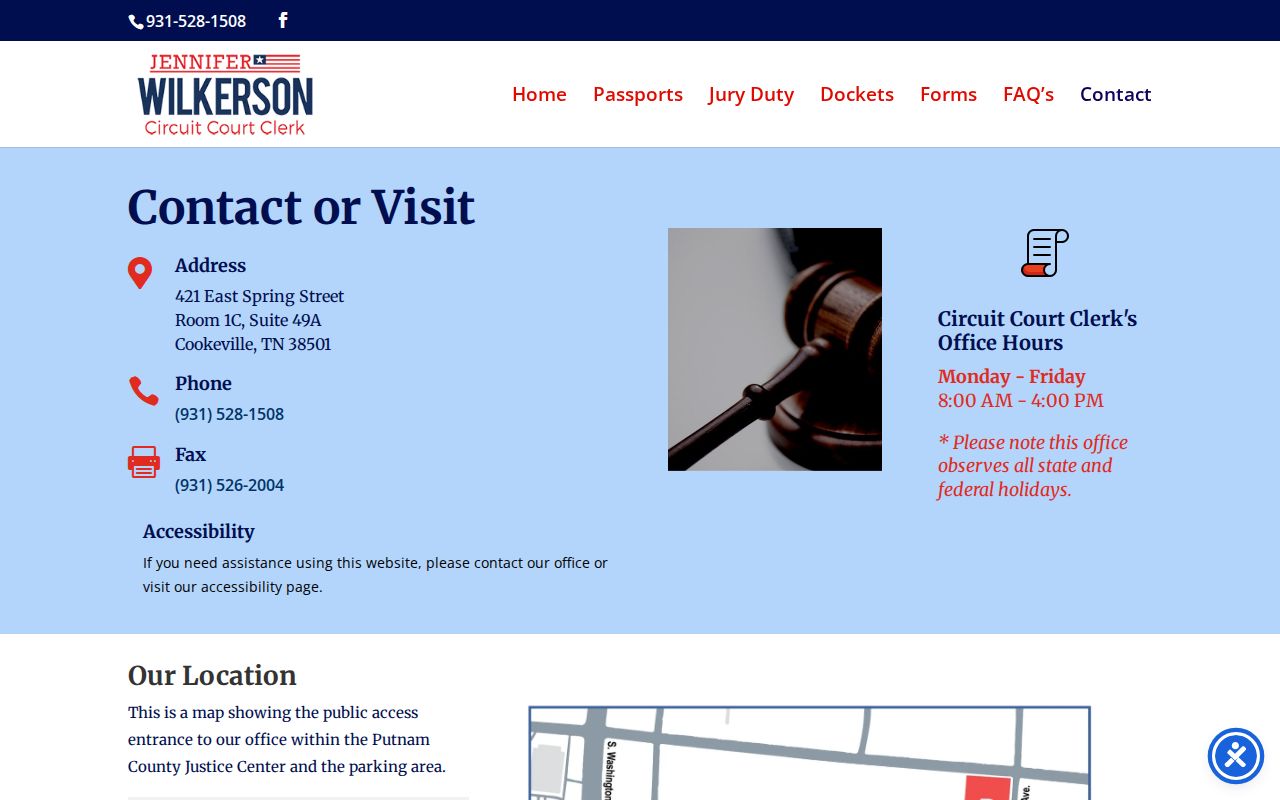
This route matters when status changed after a PDF was made or a filed order is needed. Putnam policy permits inspection and delivery by pickup, mail after postage, or email. Within seven business days, the custodian provides the record, denies in writing, or gives an estimated completion date. Inspection is free, while copy, labor, vendor, and postage charges may apply.
Public Access and Sealed Criminal Dockets
Tennessee Supreme Court Rule 34 starts with public access to case records, but it preserves statutory confidentiality, seals, protective orders, drafts, and internal judicial material. A public Putnam County criminal docket does not make every filed image or personal field open. A case number without a document may reflect a restriction instead of a missing file.
Tennessee Rule 114 makes dependent and neglect juvenile proceedings confidential. Delinquent and unruly matters follow different rules. Expungement begins in the local court and is not automatic. An ordinary request cannot bypass a seal, confidentiality rule, or expungement order.
Key Rules:
Tennessee Supreme Court Rule 34 recognizes public inspection subject to law, rules, and court orders.
Tennessee Public Records Act guidance explains custodian requests, inspection, fees, and citizen access.
Tennessee Rule 114 sets juvenile confidentiality and closure rules.
Ask for a redacted public copy when only part is confidential. If access is denied, request the legal basis. T.C.A. §10-7-505 permits a court petition over a denial, but it does not cancel a valid sealing order.